
8 Best Free Data Recovery Software for Windows (2026): Reviewed & Ranked
The best free Windows data recovery tools should restore deleted or lost files without forcing a subscription on day one. We evaluated 20 Windows-focused free-tier and fully-free recovery utilities across Windows 11 (24H2), 10, 8, and 7 — ranked on NTFS recovery capability, free-tier caps, installation safety, and community feedback from r/techsupport, r/datarecovery, Trustpilot, and independent testing. Here are the eight that actually deliver in 2026.
+ 6 honorable mentions
· community reports
internal + external
Win 11 24H2 verified
EaseUS Data Recovery Wizard Free is the best free Windows data recovery software in 2026. Its 2GB free ceiling (500MB default plus 1.5GB unlocked via a one-time social share) is the largest among GUI-based tools, and the scanner sits near the top on NTFS, FAT32, and exFAT — the file systems covering every Windows drive you’re likely to hand it. Recuva is the strongest unlimited free alternative for straightforward undeletes on a drive that still mounts normally. Windows File Recovery is worth knowing about as Microsoft’s own free utility — command-line only, but fully free with no cap.
 EaseUS Data Recovery Wizard Free
- Up to 2GB free — 500MB baseline plus 1.5GB unlocked via social share
- NTFS, FAT32, exFAT scanner sits at the top tier on recent deletions
- Works on every Windows version from 7 through 11 24H2
- Thumbnail preview before you commit any of the 2GB quota
 Recuva
- No size cap, no file-count cap, no watermark on restored files
- Wizard delivers first results in under a minute for non-technical users
- Recovery-chance indicator per found file — green, yellow, red
- Portable build runs from a USB stick without touching the target drive
 Windows File Recovery
- Microsoft-supported, installs from the Microsoft Store — no third-party download
- NTFS in all three modes (Regular, Segment, Signature); FAT32/exFAT/ReFS via Signature
- Unlimited recovery — no size cap, no file-count cap, ever
- Command-line only — requires comfort with PowerShell or Command Prompt
- 1EaseUS Data Recovery Wizard Free – Largest Free Cap, Strongest NTFS
- 2Recuva – Unlimited Free Native Windows Utility
- 3Windows File Recovery – Microsoft’s Official Free CLI Tool
- 4Puran File Recovery – Unlimited Freeware, Three-Mode Scanner
- 5Stellar Data Recovery Free – Best BitLocker & RAW Support
- 6PhotoRec – Unlimited Open Source Signature Carver
- 7DMDE Free Edition – Deepest Sector-Level Scanner
- 8Wondershare Recoverit Free – Fragmented Video Specialist
8 Best Free Windows Data Recovery Software – Quick Comparison
The Windows free-tools market splits into three camps worth recognizing before downloading anything. Polished freemium GUIs (EaseUS, Stellar, Recoverit, Disk Drill) put the friendliest interface around a capped free tier. Fully-free Windows-native options (Recuva, Windows File Recovery, Puran) trade some polish for no recovery limits. Open-source sector carvers (PhotoRec, DMDE) go furthest on corrupted or formatted NTFS at the cost of a steeper learning curve. Match the camp to your scenario below.
| Tool | Overall Strength | File Systems | Win 11 Support | Ease of Use | Free Limit | License | Best For |
|---|---|---|---|---|---|---|---|
| EaseUS DR Wizard Free | Excellent | NTFS, FAT32, exFAT, ReFS | Full 24H2 | Excellent | 2 GB (500 MB + share) | Freemium | Most users wanting a GUI |
| Recuva | Very Good | NTFS, FAT32, exFAT | Works, no active updates | Excellent | Unlimited | Freemium | Simple undeletes |
| Windows File Recovery | Very Good | NTFS, FAT32, exFAT, ReFS | Native (Win 10 2004+) | Steep (CLI) | Unlimited | Free (Microsoft) | Tech-comfortable users |
| Puran File Recovery | Very Good | NTFS, NTFS5, FAT12/16/32 | Works on 24H2 | Dated UI | Unlimited | Freeware (personal) | NTFS partition recovery |
| Stellar Data Recovery Free | Very Good | NTFS, FAT, exFAT, ReFS | Full 24H2 | Excellent | 1 GB | Freemium | BitLocker & RAW drives |
| PhotoRec | Excellent | All major + ReiserFS | Full 24H2 | Steep (text UI) | Unlimited | GPL v2+ OSS | Formatted NTFS / RAW |
| DMDE Free | Very Good | NTFS, FAT, exFAT, ext | Full 24H2 | Steep | 4,000 files / dir | Freemium | Corrupted drives |
| Wondershare Recoverit Free | Good | All major | Full 24H2 | Excellent | 100 MB | Freemium | Fragmented video |
Overall-strength labels reflect editorial evaluation based on feature coverage, independent testing cross-references, and user-feedback patterns — not an in-house benchmark. Free limits and licensing are from each vendor’s current product pages as of April 2026.
8 Best Free Windows Data Recovery Software – In-Depth Reviews
1. EaseUS Data Recovery Wizard Free – Largest Free Cap, Strongest NTFS
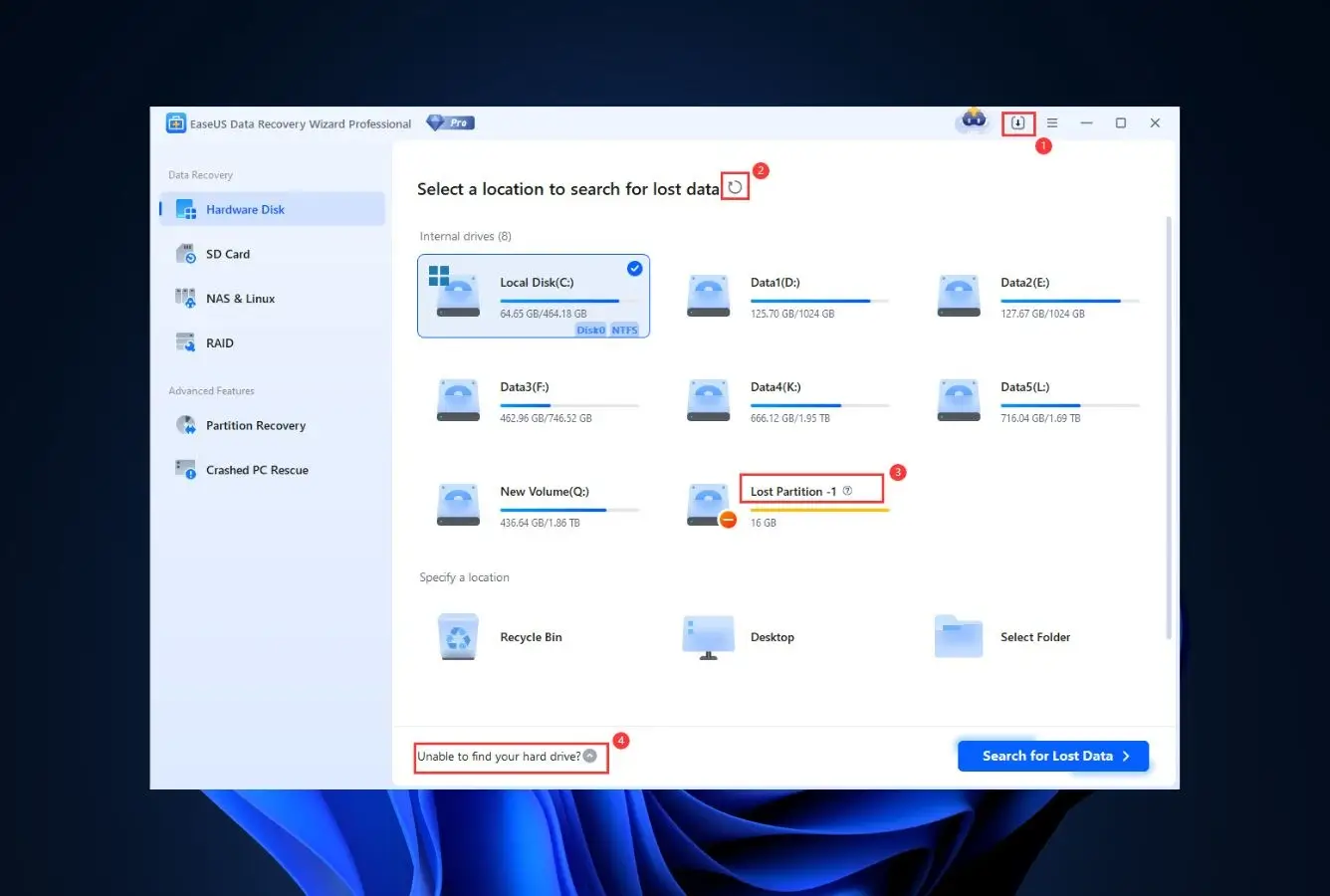
EaseUS Data Recovery Wizard Free is the Windows freemium tool to beat in 2026. The default free allowance opens at 500MB, a single social-share prompt lifts that to 2GB, and from there you have enough headroom to recover a folder of documents, a stack of photos, and a short video clip without hitting the cap. The reason it earns the top spot on a Windows-focused page isn’t the cap though — it’s the NTFS scanner. Cross-referenced third-party testing consistently places EaseUS in the top two on NTFS recovery across recently deleted files, emptied Recycle Bin contents, and quick-formatted drives. Community feedback on r/techsupport and Trustpilot reflects the same pattern: first-attempt success on most simple-to-moderate Windows scenarios. The preview pane is also the most useful in the category — thumbnails render before you spend any of the 2GB quota, so nothing gets wasted on files you don’t need.
- Largest GUI free cap in the category — 2GB is roughly ten times what Disk Drill or Recoverit allow on Windows
- NTFS scanner consistently places in the top tier on third-party testing for deleted and quick-formatted drives
- Windows 11 24H2 is a first-class target — vendor publishes 24H2 compatibility in release notes
- Every installer build includes both 32-bit and 64-bit handling and works back to Windows 7 unchanged
- Preview pane renders thumbnails for over 1,000 file types before any quota is consumed
- 2GB ceiling starts to bite if you’re recovering large photo libraries, multi-hour video, or a full user folder
- Social-share prompt re-appears during the session until completed — a minor but persistent nag
- Paid tier defaults to auto-renewing subscription at $69.95/year — worth a calendar reminder if you upgrade
A scanner that genuinely earns its first-place ranking on Windows.
The engine handles NTFS, FAT32, exFAT, and ReFS — every file system Windows ships with. Independent testing on deleted-file scenarios, emptied Recycle Bin contents, and quick-formatted drives routinely places EaseUS in the top two among GUI tools. Coverage for the 1,000+ file types includes current mirrorless RAW formats (Canon CR3, Nikon NEF, Sony ARW, Fujifilm RAF) that some competitors still miss. The free tier doesn’t throttle the scanner itself — only the save step is capped — so the question at the 2GB cap is which files to save, not whether the scanner saw them.
Three clicks to scan, one more to recover — the Windows benchmark.
Select a drive, hit Scan, wait for results to populate, and browse them filtered by type, path, or date modified. That’s the workflow. First-time users recover files without reading documentation, which is the single most consistent positive signal across G2 and Trustpilot reviews. The 24H2 build runs natively — no compatibility shim, no launch-time delay, no scaling issues on high-DPI displays. The Windows 7 build, for users stuck on legacy hardware, uses an older UI shell but the same scanner core.
Free covers most single-incident Windows recoveries under 2GB.
For a user recovering an accidentally emptied Recycle Bin or a handful of documents and photos, 2GB is enough and the free tier is the finished product. Upgrading to Pro ($69.95 annually with auto-renewal on by default) only makes sense if you’re restoring hundreds of gigabytes or need advanced features like email recovery and RAID support. Lifetime licenses appear periodically at discount but aren’t a standing offer. Download only from the easeus.com domain; community reports flag repackaged installers on aggregator sites as the most common adware vector for this specific product.
2. Recuva – Unlimited Free Native Windows Utility
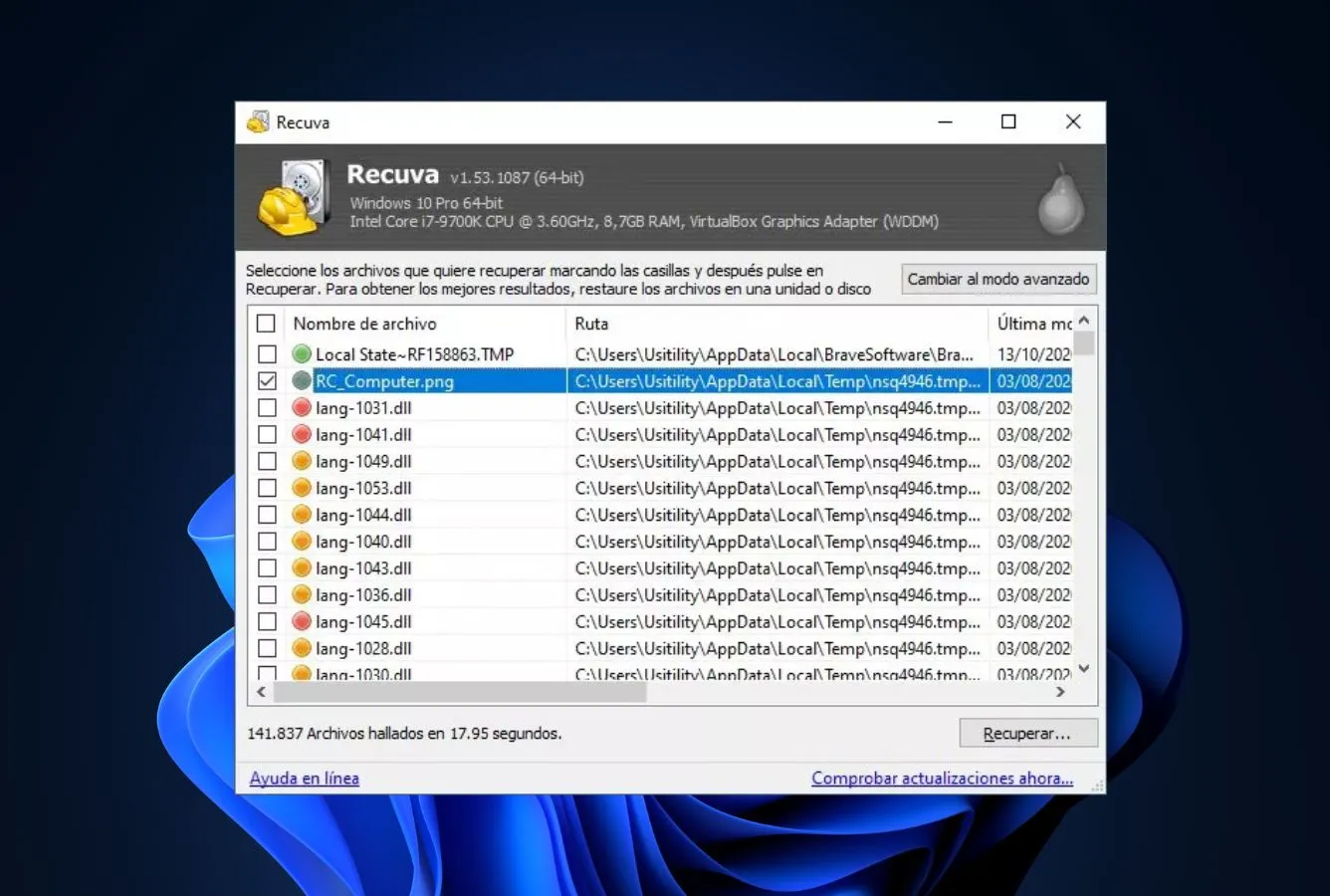
Recuva has been Piriform’s default Windows undelete tool since 2007, and for the specific scenario it targets, no freemium competitor has displaced it. The free tier imposes no size cap, no file-count ceiling, and no watermark on recovered files — three restrictions every paid-GUI competitor applies. The catch is scope rather than quality: Recuva’s scanner is built for the scenario most Windows users actually face (a file deleted this week, a folder emptied from the Recycle Bin, a USB stick accidentally formatted) and excels there. Push it into corrupted file systems, RAW drives, or BitLocker-encrypted volumes and it loses ground to Stellar, PhotoRec, and DMDE quickly. The signal that matters here: Recuva hasn’t had a major update since 2022, but the engine still works reliably on Windows 11 24H2 for the scenarios it’s designed for.
- Zero free-tier restrictions — no size cap, no file count, no watermark, scan the entire drive
- Recovery-chance indicator per file (green/yellow/red) tells you which are worth the time before recovery starts
- Wizard mode gets a non-technical user to first results in under sixty seconds
- Deep Scan catches files the quick pass misses on quick-formatted and emptied-bin scenarios
- Portable build runs from a USB stick — no installation onto the drive you’re trying to recover
- Weakens noticeably on RAW drives, BitLocker volumes, and newer mirrorless RAW photo formats
- Last major update was 2022 — stable on Win 11 but the codebase is no longer actively developed
- CCleaner bundle prompt appears pre-checked in the installer — uncheck it during setup unless you want CCleaner
Top-tier on the undelete scenarios most Windows users actually hit.
Deleted a file, emptied the Recycle Bin, Shift+Deleted by accident, quick-formatted a USB stick — Recuva handles all four near the top of third-party testing for Windows-only tools. Recent NTFS deletions on a healthy drive are where the per-file recovery-chance indicator really earns its keep: green means the file data is intact and filename is preserved, red means another file has overwritten the space. Weakness shows up outside the comfort zone: BitLocker, RAW partitions, heavily fragmented video, and current mirrorless RAW photo formats are where newer tools leave Recuva behind.
Every design decision serves the first-time user.
Wizard mode asks four questions (drive, file type, deep or quick, confirm) and shows results. Advanced mode exposes scan-by-filename, include-non-deleted, and secure-delete toggles for users who want them without making them mandatory. Image preview works inline in the results pane; document preview does not. Keyboard shortcuts are present but not required. First-time users reach a working recovery workflow without opening documentation — still a rare achievement in this category, especially considering the product last shipped a major update nearly four years ago.
The free tier is the tier — Professional is mostly marketing.
Recuva Professional runs $19.95/year and adds virtual hard drive support, automatic updates, and premium email support. For most home users, none of those three features changes recovery outcomes. The free version does the real work. Two practical notes: the installer pre-checks a CCleaner bundle (uncheck during setup), and the Piriform download page is the only safe source — repackaged Recuva builds on third-party aggregator sites remain the single most-flagged adware complaint for this product in community reports.
3. Windows File Recovery – Microsoft’s Official Free CLI Tool
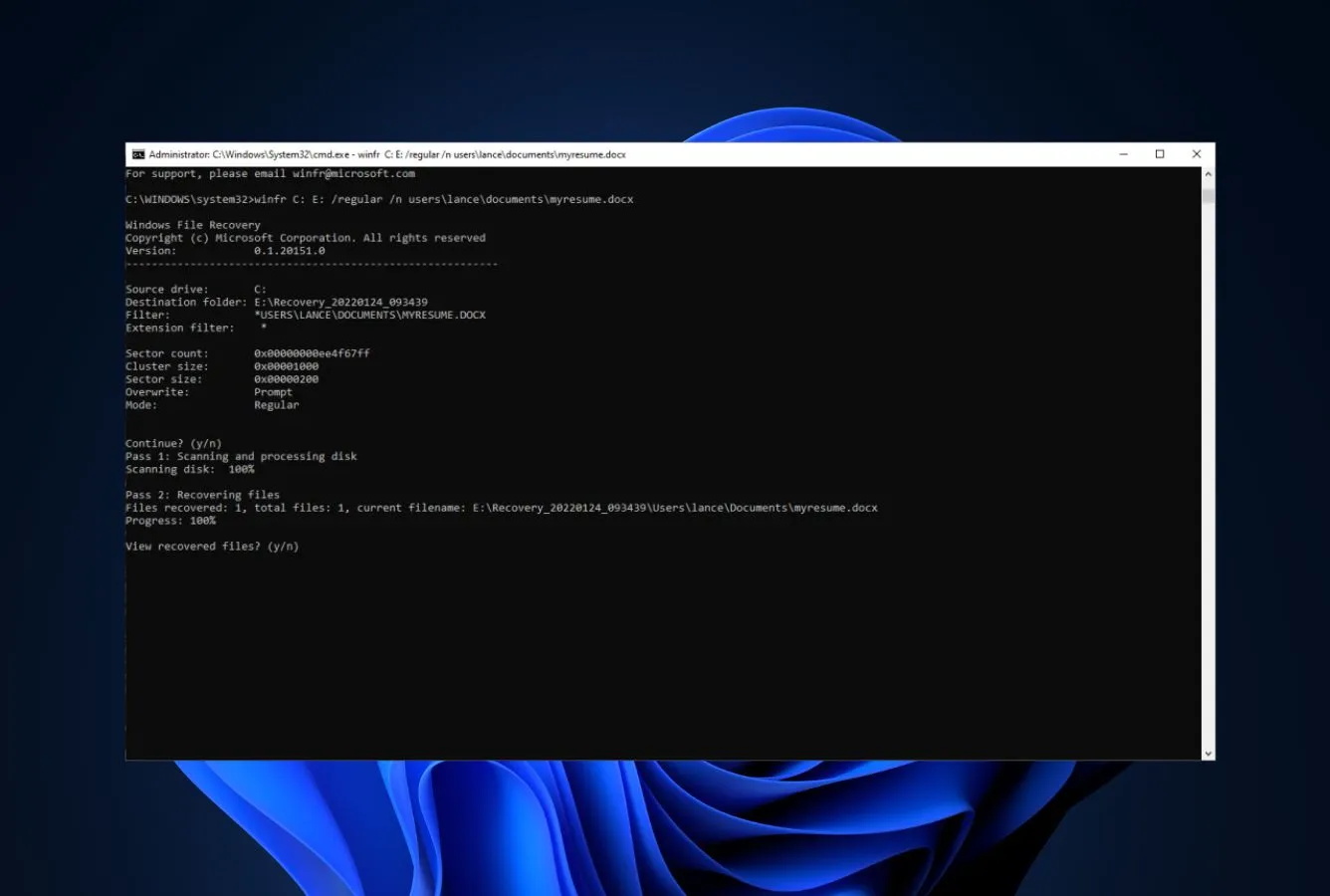
Windows File Recovery is the only recovery utility on this list that Microsoft actually publishes and maintains. Install it from the Microsoft Store, run `winfr` from PowerShell or Command Prompt, and it reads NTFS, FAT32, exFAT, and ReFS drives for deleted files. The tool ships three modes: Regular reads the NTFS Master File Table for recently deleted entries (fast, effective on healthy NTFS drives); Segment reads MFT segments for more damaged NTFS scenarios; and Signature does file-carving on FAT32, exFAT, and ReFS drives where NTFS-specific methods don’t apply. It’s the only fully-free recovery tool with the official Microsoft Store signature and Windows security baked in — every alternative on this list asks you to trust a third-party installer. The cost of that trust is the interface: there is no GUI. Every operation happens through a command-line syntax that requires looking up switches.
- Microsoft-signed and published — installs from the Microsoft Store with Windows security guarantees
- No trial, no nag screen, no upsell — the tool is unambiguously free and will stay that way
- Three scan modes cover most NTFS, FAT32, exFAT, and ReFS recovery scenarios without a second tool
- Unlimited recovery — scan a multi-terabyte drive and restore everything it finds with no cap
- Runs natively on every Windows 10 version 2004+ and all Windows 11 releases including 24H2
- Command-line only — no graphical interface, no clickable file picker, no thumbnail preview
- File-format coverage (~400 types) is narrower than PhotoRec’s 480+ or EaseUS’s 1,000+
- Community reports suggest lower hit rates than mature third-party tools on formatted or corrupted drives
Genuinely competitive on fresh NTFS deletes; loses ground elsewhere.
Regular mode handles recently deleted files on a healthy NTFS drive at roughly the level of Recuva’s quick scan — fast, reliable, filename-preserving. Segment mode digs into the MFT more aggressively and works when Regular mode finds nothing. Signature mode falls back to file-carving for FAT32 and exFAT — here it’s functionally equivalent to PhotoRec but with a narrower signature set (~400 file formats vs PhotoRec’s 480+). On formatted or severely corrupted drives, community reports on r/DataHoarder and r/techsupport consistently place Windows File Recovery below EaseUS, Puran, and PhotoRec for total recovered file count. For healthy-NTFS scenarios, it’s fully competitive.
A tech-admin’s tool with no on-ramp for anyone else.
Every operation runs through `winfr source: destination: /mode /filter`. The Microsoft support page documents every switch, but the syntax isn’t self-evident and there’s no discoverability. A tech-comfortable Windows admin masters the command in ten minutes and is productive. A non-technical user hits a wall and bounces. Third-party GUI wrappers like WinfrGUI exist and make the underlying tool accessible, but they’re unofficial — installing them defeats the “trust Microsoft’s signed build” reason to choose Windows File Recovery in the first place.
Unambiguously free forever, backed by Microsoft directly.
Windows File Recovery has no paid tier, no subscription, and no upgrade prompts. It’s shipped through the Microsoft Store as a first-party utility with no commercial pressure. For tech-comfortable users whose scenarios sit within the tool’s sweet spot (recent NTFS deletions, emptied Recycle Bin on an NTFS system drive, Signature-mode recovery on exFAT USB drives), it delivers real value at zero cost. For everyone else, the CLI barrier means PhotoRec offers the same unlimited recovery with broader format coverage, and EaseUS Free offers a better experience under 2GB.

4. Puran File Recovery – Unlimited Freeware, Three-Mode Scanner
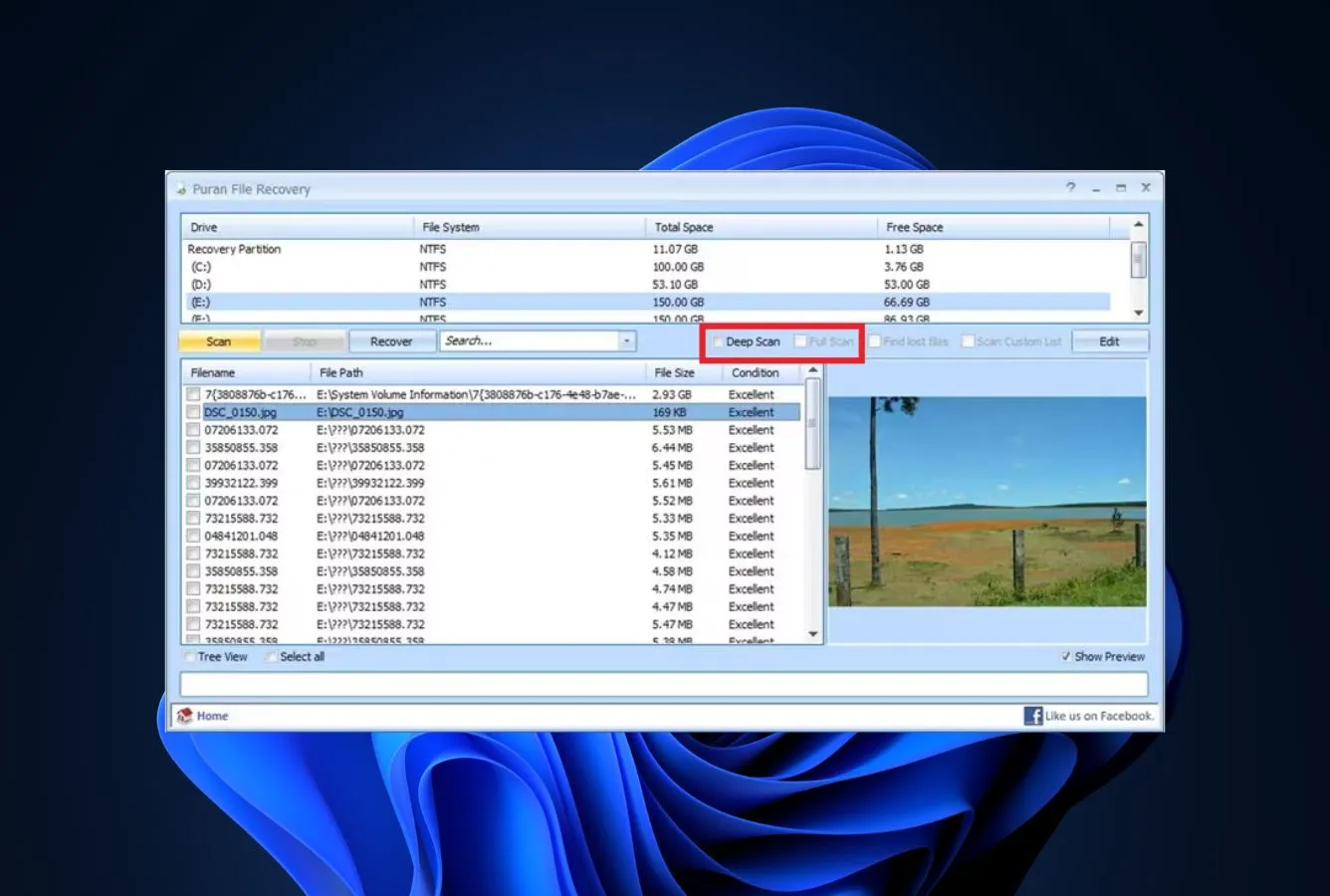
Puran File Recovery is the quiet veteran of Windows freeware recovery. Puran Software (a small Indian developer) has kept the tool available at version 2.0.1 with continued Windows 7 through 11 compatibility, and the value proposition is exactly what every freemium tool isn’t: genuinely unlimited recovery, no cap, no upsell, no subscription. The scanner ships three modes (Quick reads FAT/NTFS index entries, Deep performs byte-by-byte signature matching with 50+ patterns, Full extends Deep Scan to partition discovery on RAW drives), which is the same architectural approach Microsoft uses in Windows File Recovery but with an actual GUI. The interface is dated — the G2 reviews consistently flag it as “looks very old” — but the tree-style results view preserves NTFS folder structure and the condition indicator (Excellent/Good/Poor) gives you realistic expectations per file before recovery.
- Genuinely unlimited free for personal use — no size cap, no file cap, no watermark, no nag
- Three distinct scan modes (Quick, Deep, Full) cover everything from simple undeletes to RAW partition discovery
- Recovered files retain their original NTFS folder structure — a rarity among signature-based scanners
- 50+ signature patterns expandable by user — add support for file types Puran doesn’t recognize by default
- Tiny installer (50MB RAM, 50MB disk), portable enough to run from a USB stick in an emergency
- Interface design is visibly dated — Windows XP-era aesthetics on a 2026 Windows 11 desktop
- Deep Scan on multi-terabyte drives takes multiple hours with no session save or resume capability
- No official Windows 11 certification — works on 24H2 via community confirmation, not vendor claim
Three scan modes, no artificial ceiling — and it mostly just works.
Quick Scan handles the standard Windows scenarios — emptied Recycle Bin, Shift+Delete, quick-formatted drive — by reading the FAT or NTFS index for entries marked deleted. Deep Scan then dives sector-by-sector with signature matching against 50+ built-in patterns (user-expandable), which is where Puran holds its own on formatted NTFS drives. Full Scan extends Deep Scan to RAW drive discovery and partition reconstruction — the same territory DMDE and TestDisk cover. Community feedback suggests mid-tier results versus EaseUS and PhotoRec on formatted recoveries, but the unlimited tier without any nag or cap puts Puran in territory most freemium tools can’t match.
2006 aesthetic, 2026 working software — not always the same thing.
The tree-view results pane mirrors Windows Explorer and preserves NTFS folder structure, which is genuinely useful when recovering thousands of files. Wildcards in the search box let you filter results before recovery. The Condition column (Excellent through Poor) sets realistic expectations before you spend time recovering. The rough edge is everything aesthetic: icons, fonts, dialog widgets, and installer UI all feel like a decade-old tool. First-time users figure it out in five minutes despite the dated look — the workflow itself is sound even when the visual design isn’t.
Free for personal use, period — no tier, no upgrade, no gate.
Puran Software’s licensing terms treat Puran File Recovery as free for personal use with no commercial-use gate that would affect typical home scenarios. There is no Pro tier, no subscription, and no unlock screen. The developer ships Puran Utilities and Puran Defrag as companion tools also under similar terms. For Windows users who’ve hit EaseUS’s 2GB cap, who don’t want to touch a command line for Windows File Recovery, and who don’t need Stellar’s BitLocker specifically, Puran is the most practical free-and-actually-free option in this ranking.

5. Stellar Data Recovery Free – Best BitLocker & RAW Support
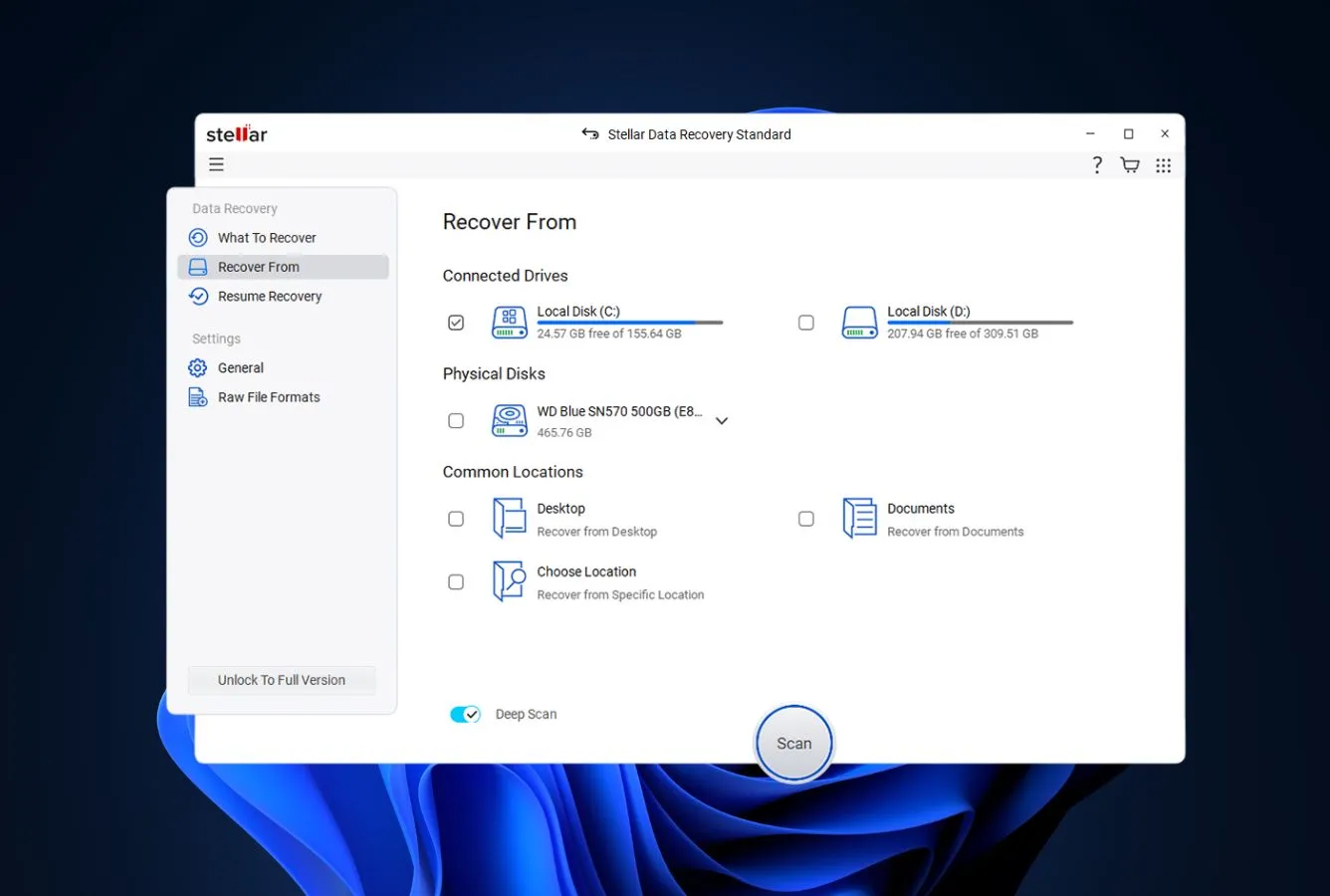
Stellar Data Recovery Free sits at fifth not because it’s weaker than the tools above — it genuinely isn’t — but because the 1GB cap means most Windows users won’t stay in the free tier long enough to fully benefit. What Stellar earns its spot with is the one feature no other free tool on this list offers: it can recover data from BitLocker-encrypted volumes when you have the recovery key, and it handles RAW drives (volumes that Windows marks as “needs to be formatted”) with a success rate that competes with paid-only tools. Independent testing places Stellar’s scanner in the upper tier on mirrorless RAW photo recovery and recently-deleted office documents, and the free tier runs the full scanner — the 1GB cap only bites at the save step. For Windows users whose data is on a BitLocker drive or a RAW-reporting partition, Stellar Free is worth the install even if you never recover past 1GB.
- Only free tool on this list with full BitLocker recovery-key support for encrypted Windows drives
- RAW drive handling is noticeably stronger than most freemium alternatives — often finds what others can’t
- Current Windows 11 24H2 certified build, with dedicated versions for older Windows 7 and 8 systems
- Unlimited preview of scanner results before the 1GB recovery cap applies
- Supports creating bootable USB recovery media — useful when the system drive itself is the target
- 1GB free cap is half what EaseUS offers — meaningful constraint for anything more than a small recovery
- Paid tiers start at $79.99/year, the highest subscription pricing among mainstream freemium tools
- Deep Scan can become unresponsive on drives with severe file-system corruption — community reports flag this
Where Stellar earns its ranking: BitLocker, RAW drives, and bootable media.
Three capabilities separate Stellar from the eight tools above it in this ranking. First: BitLocker-encrypted volume recovery, which requires only that you have the recovery key — the other free tools either skip BitLocker entirely or refuse to scan beyond the locked volume wrapper. Second: RAW drive handling, where Windows reports “drive needs to be formatted” and most tools find nothing; Stellar’s scanner reconstructs the file system from backup sector metadata and often recovers intact folder structures. Third: bootable USB media creation for recovering from drives where the Windows install itself is compromised. Outside these three capabilities, Stellar’s scanner is solid but unexceptional versus EaseUS on standard NTFS scenarios.
Three-step wizard, genuinely polished, Windows-11-native from day one.
The workflow is straightforward: pick file types, pick a drive, scan, preview, recover. The Windows 11 build uses the Fluent Design System and feels native on 24H2 rather than ported. Preview thumbnails render for images; short-form video previews play inline. The scan-progress dialog reports time remaining with reasonable accuracy, which is more than Puran or DMDE offer. The only UX friction point is Deep Scan — on drives with severe corruption, the scanner can hit a cluster it can’t parse and become unresponsive; community reports suggest this is rare but recurring enough that saving scanner state periodically is worth doing.
1GB free is enough for most recoveries if the problem is BitLocker, not volume.
The 1GB cap is half what EaseUS offers, but for Stellar’s actual use case — BitLocker unlocks, RAW partition reconstruction, bootable-media recovery — 1GB is often enough. These scenarios typically involve recovering specific files (the presentation, the wedding photos, the tax return PDFs) rather than bulk restoration. Paid tiers start at $79.99/year for Stellar Professional, which is the highest subscription on this list; the Technician edition adds RAID support and virtual-machine recovery at substantially higher tiers. For most users the free version does the BitLocker unlock and that’s the end of the transaction.

6. PhotoRec – Unlimited Open Source Signature Carver
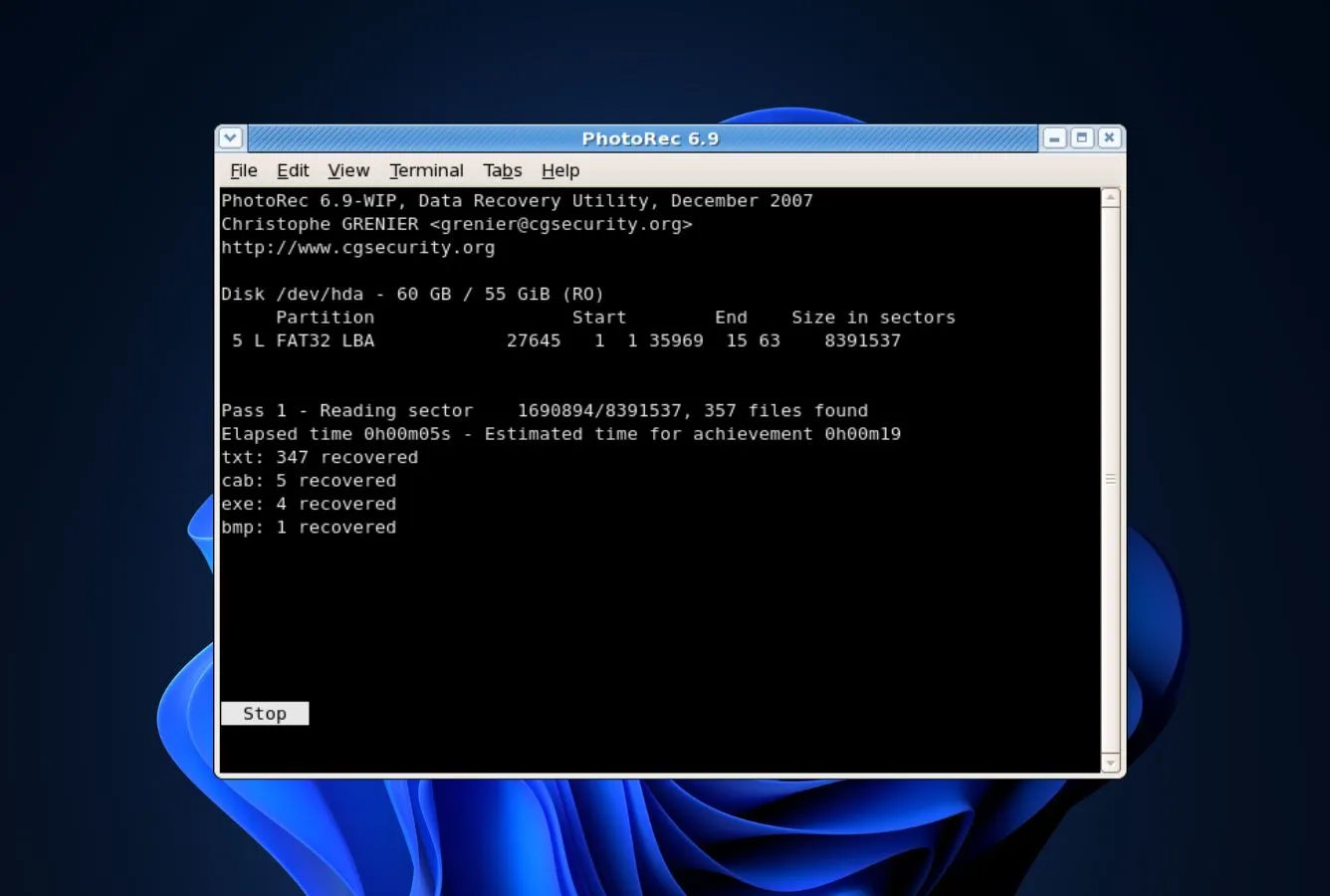
PhotoRec sits lower in this Windows-focused ranking than it does on cross-platform lists — not because it’s weaker on Windows, but because Recuva, Windows File Recovery, and Puran all offer unlimited free recovery with more Windows-friendly interfaces. Where PhotoRec still earns its place is on the scenarios those three handle poorly: badly corrupted NTFS volumes, partition tables that have been overwritten, drives that Windows reports as 0 bytes or fails to mount. Because PhotoRec ignores the file system entirely and scans sectors for 480+ signature patterns, it works on drives where Recuva’s NTFS parser gives up. The qPhotoRec Windows wrapper adds a graphical file-type picker that softens the onboarding from the raw text-mode tool, and the CGSecurity Windows build ships with both 32-bit and 64-bit binaries signed and ready for Windows 11 24H2.
- Finds files on NTFS drives that other Windows tools can’t parse — badly corrupted MFT, destroyed partition table, 0-byte drives
- 480+ file signatures cover every mainstream Windows format plus mirrorless RAW, archive, and database files
- qPhotoRec graphical wrapper provides a Windows-native file-type picker for users uncomfortable with the text-mode UI
- Fully open source under GPL v2+ — no paid tier, no donation gate, no registration
- Physically read-only on the source drive — the tool can’t overwrite or corrupt the drive you’re recovering from
- Text-mode UI (or basic qPhotoRec wrapper) is a real Windows UX downgrade vs EaseUS, Recuva, or Stellar
- Original filenames and folder structure don’t survive — files come back as f00001234.ext for manual sorting
- No selective recovery — once a file type is enabled, every detected instance comes back
The last-resort tool that actually does the job when others fail.
PhotoRec’s signature-based carving ignores NTFS metadata entirely, which is exactly the property you need when the metadata is corrupted. On drives where Windows reports “the volume does not contain a recognized file system” or where Recuva completes with zero results, PhotoRec routinely returns thousands of recoverable files. Independent testing on severely corrupted NTFS volumes places PhotoRec in the top tier for total recovered file count, often exceeding paid tools in the same scenario. The tradeoff — no filenames, no folders, no selective recovery — is real but well-understood before you start.
qPhotoRec softens the onboarding, but the Windows UX is still a step down.
The CGSecurity Windows build includes both the original text-mode photorec.exe and qPhotoRec.exe, the latter being a basic graphical wrapper with a drive selector, partition picker, file-type checklist, and output folder. For Windows users, qPhotoRec is the starting point — it handles the onboarding friction while still exposing all of PhotoRec’s capability. Scans run live with a file-count ticker, and the output folder fills as files are recovered. Expect multiple hours on terabyte drives and no resumable session if the scan is interrupted.
The cost is interface; the benefit is unlimited, unconditional recovery.
PhotoRec is GPL v2+ open source from CGSecurity and will remain that way permanently. Download the Windows ZIP from cgsecurity.org, unzip, run qPhotoRec.exe — the full setup is under five minutes. For Windows users who’ve hit the EaseUS 2GB ceiling, whose drive is too damaged for Recuva, and whose scenario isn’t purely NTFS undelete (where Windows File Recovery does the job), PhotoRec is the answer. The interface tax is worth it for the results it delivers on drives nothing else can touch.

7. DMDE Free Edition – Deepest Sector-Level Scanner
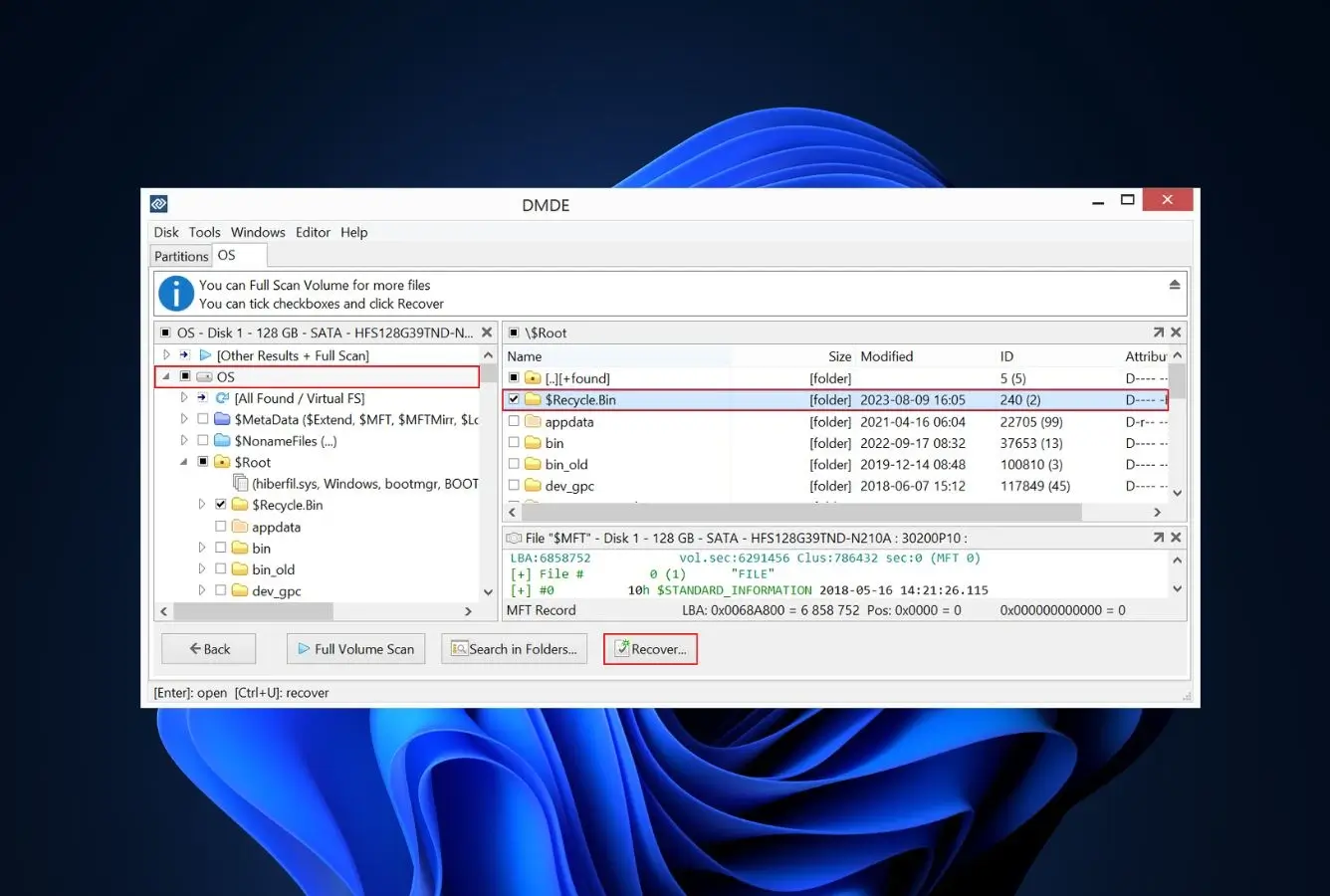
DMDE is the tool experienced Windows users install when the mainstream options have all failed. Developer Dmitry Sidorov has shipped DMDE since 2006 with steady annual updates, and the architectural approach is different from every other tool on this list: it’s a disk editor first, a recovery suite second. That means you can inspect raw NTFS Master File Table entries, partition boot sectors, and individual data clusters — then reconstruct what other tools silently skip. The 4,000-files-per-directory cap on the free edition rarely bites in practice since real Windows folders almost never exceed that count, and there’s no file-size limit, so a single 60GB video recovered from a corrupted drive is handled without ceremony. The interface is uncompromisingly technical — this is not Puran, let alone EaseUS — but for the class of scenario it’s built for, it outperforms paid Windows tools costing $100+.
- 4,000 files per directory is effectively unlimited — most Windows folders hold a few hundred to a few thousand files
- No per-file size cap — recover a 60GB video or a 200GB database backup in the free edition without restriction
- Sector-level disk editor reveals hidden, overwritten, or corrupted NTFS partitions that other scanners silently skip
- Successfully recovers data from Windows drives where EaseUS, Recuva, and Stellar have already returned nothing
- Paid editions start at $20 one-time — no subscriptions, no upgrade prompts, no tier-drip pricing model
- Interface assumes you know what NTFS MFT entries, partition boot sectors, and hex offsets mean
- No file preview — every recovery happens blind, with file integrity verified only after the save completes
- Documentation is accurate but written for technical audiences — a Windows novice will need a patient afternoon to learn it
The last-resort Windows tool that quietly outperforms the expensive ones.
DMDE’s sector-level approach lets it reconstruct NTFS file systems from fragmentary MFT data that other tools can’t parse. Forum threads on r/datarecovery are full of the same pattern: user tries EaseUS, Recuva, Disk Drill, fails, tries DMDE, recovers everything. Its partition-reconstruction capability overlaps with TestDisk; its file-carving overlaps with PhotoRec; but its unified interface and Windows-native binary make it the pragmatic choice when a Windows drive is damaged. The free tier runs the full scanner — only the save step is capped at 4,000 files per folder, which rarely bites on real-world drive layouts.
A proper disk-editor UI, applied to recovery — not a consumer tool pretending to be technical.
DMDE opens to a device picker, then drops you into a split view: left pane shows hex sector data, right pane shows reconstructed directory structure. No wizard, no welcome screen, no animated onboarding. Menus are dense but accurate. First-time Windows users who’ve never touched a disk editor face a genuine learning curve — plan on thirty minutes with the user guide before launching. Users familiar with disk editors or NTFS internals are immediately at home. The DMDE forum is small but technically correct, often with responses from Dmitry himself.
The best $20 you’ll ever spend on a Windows tool — if you need to spend it at all.
When the free 4,000-files-per-directory cap does bite, DMDE Standard removes it for a $20 one-time purchase — no subscription. DMDE Professional at $48 adds RAID-5/6 reconstruction; DMDE Business at $133 adds batch processing and commercial licensing. The one-time pricing model is genuinely rare in 2026 — most Windows recovery tools have shifted to annual subscriptions. For users who need recovery tooling once, or who value predictable pricing, DMDE’s licensing is the cleanest in this ranking.

8. Wondershare Recoverit Free – Fragmented Video Specialist
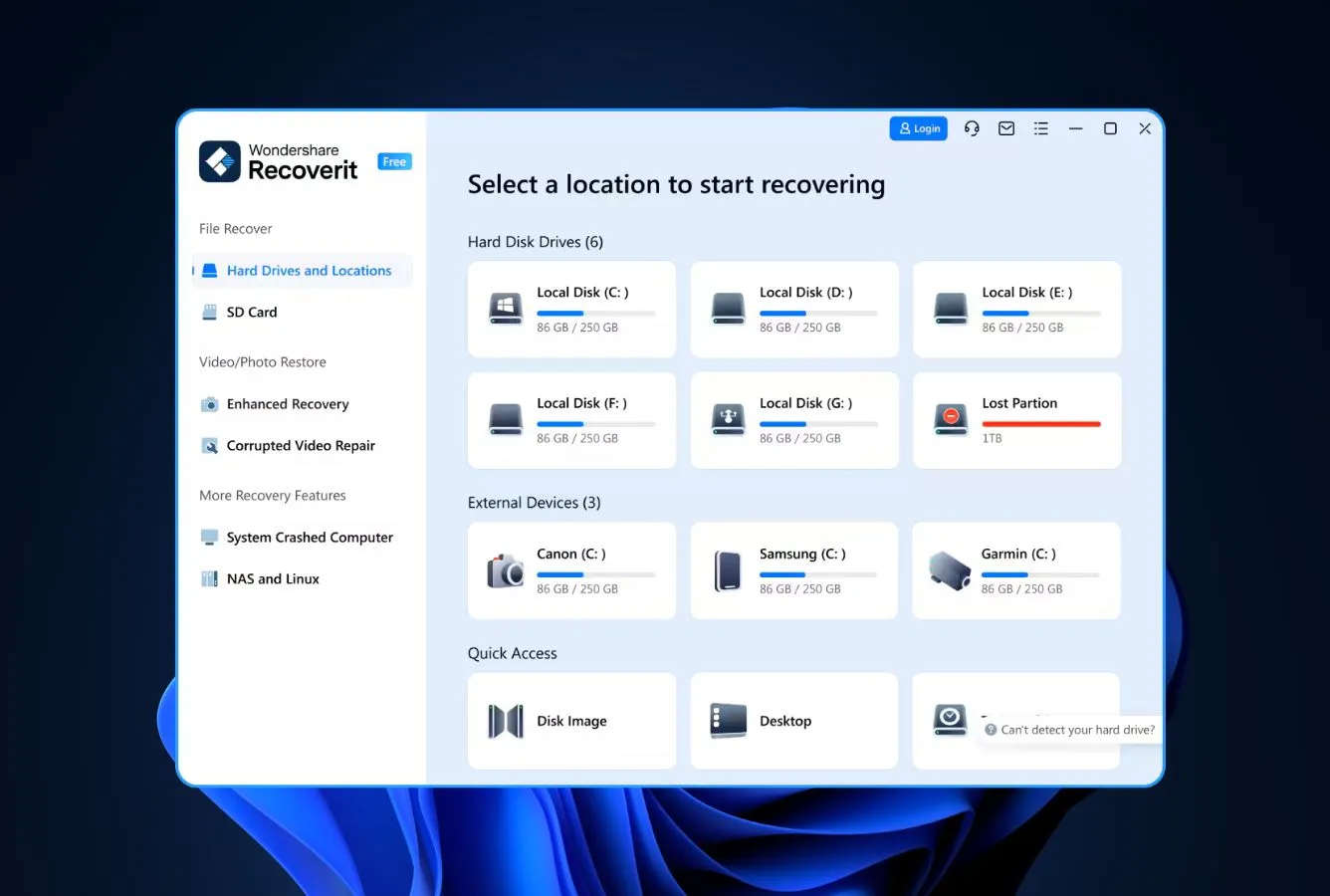
Wondershare Recoverit Free lands at eighth for a clear reason: its 100MB free Windows cap is the tightest in this ranking, and outside one specific scenario, every tool above it offers a better Windows experience. The one scenario where Recoverit genuinely differentiates is fragmented video reassembly — the Enhanced Video Recovery feature stitches together MP4, MOV, and MXF clips from drones, action cameras, and mirrorless bodies better than any other tool on this list. For a Windows user who dropped a DJI drone’s microSD card, accidentally formatted a GoPro card, or saw a Canon EOS mirrorless body corrupt a shoot, Recoverit’s 100MB free tier is enough to confirm whether the footage is recoverable before deciding to upgrade. Outside of video, the tool’s general Windows scanner is competent but unremarkable — Puran, Recuva, and EaseUS all do general Windows recovery better at the free tier.
- Enhanced Video Recovery reassembles fragmented clips from drones, action cams, and mirrorless bodies better than any free competitor
- Windows 11 24H2 is fully supported with a current native build — no compatibility shim or legacy scaffolding
- Unlimited preview of scanner results before the 100MB cap applies — confirm recovery before paying
- Clean, consistent UI that matches Wondershare’s Filmora and UniConverter lineup for Windows power users
- Broad file-system coverage including NTFS, FAT32, exFAT, and HFS+ for external Mac-formatted drives
- 100MB cap is the tightest on this ranking — three or four 4K photos and the quota is gone
- Paid plans open at $59.99/year with auto-renewal pre-checked — budget a calendar reminder if you subscribe
- Trustpilot complaints specifically flag cancellation friction — community reports make this the most-flagged billing concern in the category
Exceptional on video; average on everything else Windows users face.
Enhanced Video Recovery is the feature the Windows version of Recoverit is genuinely built around — on fragmented MP4, MOV, and MXF clips from drones, action cameras, or mirrorless bodies, it stitches back together what other tools return as unrepairable partial files. Independent testing confirms this specific strength repeatedly. For non-video Windows scenarios (deleted documents, emptied Recycle Bin, quick-formatted NTFS), Recoverit’s scanner performs comparably to Recuva and EaseUS without standing out. The tool earns its place here for the video scenario specifically; anyone choosing Recoverit for general Windows recovery is leaving better free options on the table.
Well-designed and familiar — and slightly too eager to upgrade you.
The three-step flow (select drive → scan → preview-and-recover) matches every other polished Windows freemium tool. Where Recoverit diverges is upgrade-prompt frequency: the 100MB quota surfaces a banner at the top of the results pane, and the “upgrade to unlock” CTA appears more aggressively than in EaseUS, Stellar, or Disk Drill. For a single-incident user this is mildly annoying. For repeated use, it wears on patience. The scanner itself is fast and stable on Windows 11 24H2; the polish matches Wondershare’s broader creative-tools portfolio.
100MB free, then a subscription ladder with some billing baggage.
The free 100MB is proof-of-concept territory — enough to confirm your files are recoverable before committing to a paid tier. Recoverit Standard opens at $59.99 annually with auto-renewal enabled by default. Essential ($79.99) and Premium ($99.99) tiers add features like advanced video repair and broader device support. Trustpilot threads specifically flag cancellation friction more often than Wondershare’s competitors — worth noting before you subscribe. For the narrow case of fragmented video recovery, Recoverit is genuinely useful; for everything else, better free Windows options sit higher in this ranking.
How We Evaluate Free Windows Data Recovery Tools
Every Windows recovery vendor claims high NTFS success rates, wide file-system coverage, and Windows 11 compatibility. Picking winners from marketing copy doesn’t work — a single benchmark on one unrepresentative drive can mislead anyone reading a roundup. Our evaluation aggregates three layers of evidence: vendor documentation for feature baselines, independent third-party testing for cross-referenced outcomes, and community signal from Reddit, Trustpilot, G2, and the Windows support forums for real-world user behavior. Rankings reflect patterns consistent across all three sources, not a single in-house test.
Windows versions covered: Windows 11 (including the 24H2 build), Windows 10 (1809 through 22H2), Windows 8.1, and Windows 7 SP1 — covering both 32-bit and 64-bit installs where vendors still ship those builds. Storage types covered: internal NTFS system drives (SATA HDDs, SATA SSDs, NVMe SSDs), external NTFS and exFAT drives, FAT32 USB flash drives, SD and microSD cards, and ReFS-formatted volumes on Windows 11. Key factors weighted: NTFS recovery capability (40%), usability for non-technical Windows users (20%), installation safety and Microsoft-store verification where applicable (15%), extra features like video reassembly or BitLocker support (15%), Windows-version compatibility breadth (5%), and free-tier practical value (5%).
Individual test runs, per-Windows-version compatibility notes, and tool-by-tool research logs live on our full methodology page. Start there if you want the evidence behind any ranking on this page.
Free Windows Data Recovery – Honorable Mentions
Six Windows-focused free recovery tools we evaluated but didn’t include in the main ranking. Each has a niche strength or specific constraint — usually around free-tier tightness, update staleness, or category overlap — that kept it out of the top eight.
How to Choose the Best Free Windows Recovery Tool
Stop using the affected drive the moment you notice data is missing. Every new file written to a Windows drive after a loss can overwrite the data you’re trying to recover. For an internal system drive, either shut the PC down and scan the drive from a second machine via USB adapter, or boot from a live Windows PE / Linux USB to avoid touching the drive while running the recovery tool.
NTFS, FAT32, exFAT, or ReFS — Match the Tool to the File System
Windows internal system drives are always NTFS. External HDDs formatted in Windows default to NTFS for larger drives, exFAT for cross-device drives, and FAT32 for smaller USB sticks and most SD cards. Windows 11 introduced ReFS for Storage Spaces and dev drives. Every tool in this ranking handles NTFS; most handle FAT32 and exFAT; Windows File Recovery is the only one with Signature-mode ReFS support. If you’re recovering from a USB drive or SD card, check the file system in Windows File Explorer (right-click → Properties) before picking a tool — Recuva and Puran handle FAT variants as well as NTFS.
Free-Tier Cap vs What You’re Actually Recovering
Free tiers on this ranking span 100MB (Recoverit), 500MB (Disk Drill mentioned above), 1GB (Stellar), 2GB (EaseUS), 4,000 files/directory (DMDE), and unlimited (Recuva, Windows File Recovery, Puran, PhotoRec). Match the cap to your loss: a handful of accidentally deleted Word or Excel files fits in any tier; a folder of family photos fits under 2GB with EaseUS; a multi-gigabyte video project needs an unlimited tier. For category-specific scenarios, our SD card recovery guide and cross-platform free roundup cover adjacent use cases.
Deep Scan vs Quick Scan on Windows
Quick Scan reads the NTFS Master File Table (MFT) or FAT directory entries marked as deleted — fast, usually seconds to a few minutes, and accurate for recently deleted files on a drive that still mounts normally. Deep Scan reads sectors directly and reconstructs files from signatures without relying on the MFT — slower, often several hours on multi-terabyte drives, but the only option for quick-formatted, RAW-reporting, or severely corrupted drives. Always start with Quick Scan. Escalate to Deep Scan only if Quick Scan returns nothing useful. Windows File Recovery’s Regular mode maps to Quick Scan; Segment and Signature modes map to Deep Scan variants.
Portable vs Installed — Don’t Write to the Drive You’re Recovering
Installing recovery software to the same drive you’re trying to recover from is a common mistake that can overwrite the data you’re attempting to save. Recuva, Puran File Recovery, PhotoRec, and qPhotoRec all offer portable builds that run from a USB stick without installing. Windows File Recovery installs through the Microsoft Store (to a protected Windows location, not the user’s drive). Stellar, EaseUS, Disk Drill, and Recoverit require standard installers — always install them to a different physical drive than the one holding the lost data. If the lost data is on your C: drive, install the tool to an external USB stick or a second internal drive, not to C:\Program Files.
Windows 11 24H2 Compatibility
Every current build in this ranking runs on Windows 11 24H2 (April 2026 status). EaseUS, Stellar, Recoverit, and Disk Drill explicitly test against 24H2 and publish compatibility notes. Windows File Recovery is maintained by Microsoft and updates through the Microsoft Store. Recuva’s last major release was 2022 but the engine still functions correctly on 24H2 despite the lack of active development. PhotoRec, TestDisk, and DMDE update frequently and support 24H2 natively. Puran File Recovery’s installer targets Windows 7/8/10 but community reports confirm working on Windows 11 including 24H2. If you’re on Windows 7 or 8.1 on legacy hardware, Recuva, Puran, and PhotoRec are the most reliable options.
Safety and Installer Verification
Download recovery tools only from the vendor’s canonical URL — easeus.com, ccleaner.com (Piriform’s Recuva), puransoftware.com, stellarinfo.com, cgsecurity.org (PhotoRec), dmde.com, and the Microsoft Store for Windows File Recovery. Third-party software aggregators and torrent sites repackage legitimate installers with bundled adware, and r/techsupport consistently flags repackaged Recuva and EaseUS builds as the most common source of unwanted-software complaints in this category. On first install, Windows SmartScreen or Windows Defender may flag portable tools like PhotoRec or DMDE — these are known false-positives from the signature-based carving code, not malware. Verify the download hash against the vendor’s published checksum when in doubt.
When Free Software Can’t Recover Windows Data
Recovery software operates at the file system and sector level — the moment the underlying data is overwritten, physically damaged, or inaccessible to the Windows storage stack, no amount of software will help. Match your scenario against the table below before committing hours to scans that can’t succeed.
| Your Windows situation | Software can help? | What to do instead |
|---|---|---|
| File Shift+Deleted, drive still mounts normally | Yes | EaseUS Free, Recuva, or Windows File Recovery Regular mode |
| Drive shows as RAW in Disk Management | Yes | Stellar (if BitLocker) or TestDisk/DMDE to rebuild the partition |
| System Protection enabled — lost files in user folder | Yes | Right-click folder → Properties → Previous Versions (Shadow Copies) |
| Drive clicks, grinds, or not in Disk Management | No | Stop all power-on attempts — professional cleanroom service only |
| Drive fully formatted (full format, not quick) | No | Full format writes zeros — data overwritten, not recoverable |
NTFS Shift+Delete and the Recycle Bin Bypass
Shift+Delete in Windows bypasses the Recycle Bin entirely — the NTFS index entry for the file is marked as deleted immediately, with no intermediate storage. The underlying data on disk remains intact until another file overwrites the same clusters, which means recovery software can still restore the file. Time matters here: the longer you wait and the more you use the drive, the higher the chance that another file overwrites the space. For Shift+Deleted files on an NTFS system drive, Recuva’s quick scan, EaseUS Free, and Windows File Recovery’s Regular mode all handle the scenario reliably. If the deletion happened recently and the drive has been used lightly since, success rates are very high.
Disk Management Reports the Drive as RAW
A drive showing as RAW in Disk Management means Windows can see the drive hardware but can’t interpret the file system — usually because the NTFS boot sector or Master File Table has been corrupted. This is a recovery-friendly scenario despite how alarming it looks. TestDisk (from the same CGSecurity project as PhotoRec) specializes in rebuilding the NTFS boot sector from backup copies, often restoring the drive to mountable state with all files intact and no recovery step required. If TestDisk can’t rebuild the partition, DMDE’s sector-level scanner can usually reconstruct the directory structure well enough to recover individual files. Stellar Data Recovery Free also handles RAW drives specifically — its scanner recognizes the scenario and runs a reconstruction pass by default. For harder drive-level damage that extends beyond RAW, our hard drive recovery guide covers physical-damage scenarios in detail.
Volume Shadow Copies Never Ran
Windows System Protection takes automatic snapshots of user folders (Documents, Pictures, Desktop, etc.) through Volume Shadow Copy Service — but only if System Protection is enabled on the drive. Windows 11 disables it by default on most drives to save space. If System Protection wasn’t enabled before your data loss, there are no shadow copies to restore from, and Previous Versions will show empty. You can still use third-party recovery software to find the deleted files, but the shortcut of right-click → Restore Previous Versions won’t work. Going forward, enable System Protection now: Control Panel → System → System Protection → Configure → Turn on system protection. Allocate 5–10% of drive space for snapshots.
Secure Erase or Full Format
Windows Quick Format (the default) only rewrites the file system’s allocation table — the underlying file data stays intact until overwritten. That’s why recovery works after an accidental format. But a full format — the option you get when you deselect “Quick Format” in the formatting dialog — writes zeros (or random data) across every sector of the drive, actively overwriting everything that was previously stored. Windows 10 and 11 also offer secure-erase options through BitLocker’s Format-and-Erase or diskpart’s clean all command. Drives that have been through a full format or secure-erase operation are beyond software recovery — every bit has been overwritten. Recovery software still runs, but nothing useful comes back.
NVMe SSD with TRIM Enabled
Windows 10 and 11 enable TRIM by default on all NVMe and SATA SSDs. When you delete a file, the OS sends a TRIM command telling the SSD controller that those flash cells are no longer needed. The controller then proactively erases those cells in the background, usually within minutes to hours depending on drive activity. This means data deleted from an SSD on modern Windows has a very short recovery window — often minutes, not days. If the lost data was on an SSD, urgency matters more than tool selection. Shut the machine down immediately (pull power if needed), connect the SSD to a second machine as a secondary drive (never as the boot drive), and scan it from the second machine. For SSD-specific guidance, our SSD recovery guide covers TRIM behavior in depth.
Don’t install “just one more recovery tool” onto the affected drive, don’t run a chkdsk repair pass, don’t reboot Windows repeatedly — every action can overwrite the data you’re trying to recover. For system drives, power down and connect externally; for data drives, disconnect and scan from a second PC. SSD users: the window may be minutes, not hours.
Built-in Windows Recovery Options (Check These First)
Before downloading anything, check the built-in Windows recovery options. The file you think is permanently lost may be sitting in a Recycle Bin, an automatic snapshot, a cloud sync, or a File History backup — all zero-cost, zero-install, and safer than running any third-party tool.
Windows Recycle Bin and Previous Versions
Deleted files on Windows go to the Recycle Bin unless the delete was Shift+Delete, the file exceeded the Bin’s per-drive size limit, or the Bin was disabled for that drive. Check the Recycle Bin on every Windows PC the drive has been connected to, since the Bin is per-user-per-drive. For files deleted from within an application or modified over time, right-click the parent folder in File Explorer and select Properties → Previous Versions: if System Protection is enabled, prior versions from Volume Shadow Copy restore points will appear. For Recycle Bin edge cases where the Bin was emptied, our Recycle Bin recovery guide covers what’s still possible afterward.
File History (Windows 10 and 11)
File History is the Windows built-in incremental backup system that copies versioned snapshots of Libraries, Desktop, Contacts, and Favorites to an external drive or network location — if enabled. Open Settings → Update & Security → Backup (Windows 10) or Control Panel → File History (Windows 11) to check whether File History is running. If it was on before the loss, Restore Personal Files from the File History timeline recovers versioned copies from any prior point. Most Windows users never enable File History, which is worth fixing proactively even if it doesn’t help with the current loss.
OneDrive Recycle Bin and Version History
If the lost files lived in a folder synced to OneDrive — the Documents, Pictures, or Desktop folders are synced by default on Windows 10 and 11 — check the OneDrive web interface’s Recycle Bin first. OneDrive keeps deleted files for 30 days (for personal accounts) or 93 days (for Microsoft 365 business accounts), during which they can be restored to their original location with a single click. OneDrive also keeps a Version History on individual files — right-click a file in the OneDrive web interface → Version History to roll back to an earlier version. Google Drive, Dropbox, and iCloud Drive offer equivalent features with similar retention windows.
When Built-in Options Aren’t Enough
If the file isn’t in the Recycle Bin, Previous Versions is empty, File History wasn’t enabled, and cloud sync didn’t keep a copy, the data is genuinely on the drive’s storage — deleted but not overwritten, or lost because the NTFS file system is damaged. That’s when the tools in the main ranking above become relevant. Start with EaseUS Free or Recuva for straightforward undeletes on a working drive; move to Windows File Recovery, Puran, or PhotoRec for unlimited scans; move to Stellar, DMDE, or TestDisk for BitLocker, RAW, or corrupted-partition scenarios; move to professional cleanroom service if the drive is physically damaged.
The fastest fix for Windows data recovery is never needing it. Fifteen minutes in Settings configuring File History to an external USB drive and turning on System Protection for C: eliminates most of the scenarios that even the best recovery tools can only partially address.
Final Verdict
EaseUS Data Recovery Wizard Free is the best free Windows data recovery software in 2026. Its 2GB free cap is the largest among GUI-based tools, its NTFS scanner sits at the top tier on third-party testing for recently deleted and quick-formatted Windows drives, and the three-step wizard is the friendliest path to first results in the entire category. Cross-platform support means the same installer works for users who also occasionally need to recover from a Mac drive. For a typical Windows 10 or 11 user trying to recover deleted documents, emptied Recycle Bin contents, or a quick-formatted USB stick, nothing else on this list matches the combination of recovery quality and approachability.
Beyond the winner: Recuva remains the right pick for Windows users who want unlimited free recovery with the simplest possible interface. Windows File Recovery is the one to know about if you’re tech-comfortable and want Microsoft’s own officially supported free tool. Puran File Recovery is the underrated freeware specialist — unlimited, three-mode scanner, preserves NTFS folder structure. Stellar Free earns its place specifically for BitLocker unlocks and RAW drive recovery, even at the 1GB cap. PhotoRec and DMDE sit at the bottom of the ranking not because they’re weaker but because their interface requirements make them last-resort tools for Windows users — but when the mainstream options fail, both tools routinely succeed.
Frequently Asked Questions
About the Authors


Data Recovery Fix earns revenue through affiliate links on some product recommendations. This does not influence our rankings — all tools are evaluated independently based on vendor documentation, independent third-party testing, and community feedback before any affiliate relationships are considered. If anything on this page looks inaccurate, outdated, or worth revisiting, please reach out at contact@datarecoveryfix.com and we’ll review it promptly.